
Learning goal: Match firm cash flows with WACC and interpret a DCF sensitivity grid as a conditional range of values.
Define what is being valued
This fictional business is projected to produce free cash flow to the firm, or FCFF, of ₹10, ₹12, ₹14, ₹16 and ₹18 crore at the ends of the next five years. FCFF is cash available to all capital providers after operating needs and reinvestment, before debt financing cash flows. These values are teaching assumptions, not forecasts for a listed company.
We discount firm cash flows using an assumed weighted average cost of capital, or WACC. Do not substitute cash flows after debt payments into this model while keeping WACC: that would mix two valuation approaches. The example uses nominal rupee cash flows and a nominal annual discount rate.
Work through the base case
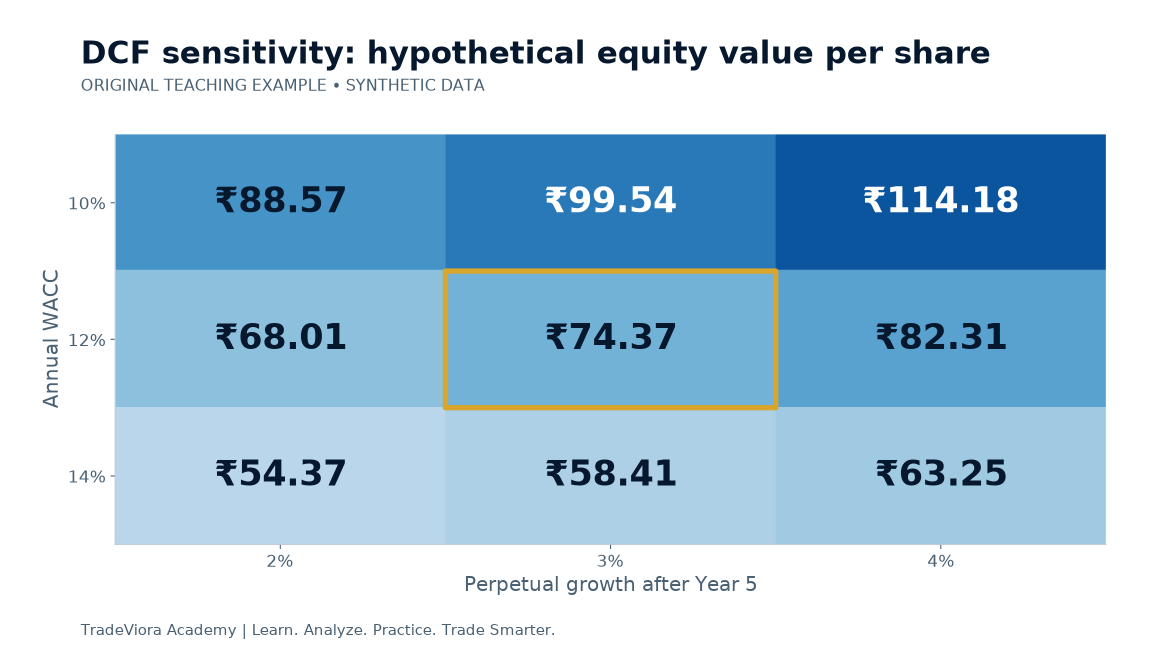
Set WACC to 12% and perpetual growth after Year 5 to 3%. Year 6 FCFF is 18 × 1.03 = ₹18.54 crore. Terminal value at the end of Year 5 is 18.54 ÷ (0.12 − 0.03) = ₹206 crore. This terminal value must also be discounted for five years; it is not cash received today.
The present value of the first five cash flows is about ₹48.84 crore. The present value of terminal value is about ₹116.89 crore. Together they give operating enterprise value of ₹165.73 crore. Add ₹8 crore of excess cash, subtract ₹25 crore of debt and assume no other claims: equity value is ₹148.73 crore. Across 2 crore shares, the model gives ₹74.37 per share.
| Input | Assumption |
|---|---|
| Year 1–5 FCFF, ₹ crore | 10, 12, 14, 16, 18 |
| Base WACC | 12% |
| Base perpetual growth | 3% |
| Excess cash / debt, ₹ crore | 8 / 25 |
| Ordinary shares, crore | 2 |
Read the sensitivity instead of admiring precision
Change WACC and terminal growth within the displayed illustrative grid while keeping the five explicit cash flows, excess cash, debt and shares fixed. The range expands substantially. That is a diagnostic exercise showing how fragile an output can be to inputs; it is not a confidence interval and does not assign probabilities to any cell.
In the base case, about 71% of operating enterprise value comes from cash flows beyond Year 5. This makes the steady-state assumptions central to the result. In a full business model, higher growth usually requires more reinvestment, which affects FCFF. Holding near-term FCFF fixed in this grid deliberately isolates the terminal-assumption effect.
Make the assumptions earn their place
A perpetual growth rate must remain below the discount rate in this formula and be plausible for the currency and economy over the long run. A mathematically valid rate can still be economically unreasonable. The business also needs enough reinvestment to support the assumed growth.
Do not choose the growth rate that produces a desired share price. Write the operating reasons for cash generation, reinvestment and risk first. Report a range alongside the base case, distinguish enterprise from equity value, and keep debt, cash and other claims visible. The value is conditional on those inputs.
Try it yourself
Why is adding the undiscounted ₹206 crore terminal value to ₹48.84 crore wrong?
Show the worked answer
The ₹48.84 crore is already in today’s money, while ₹206 crore is a value five years from now. Discount the terminal value by 1.12⁵ to about ₹116.89 crore before adding them. Mixing valuation dates overstates the present value.
A valuation is conditional on cash flow, timing and risk assumptions; show their influence openly.
Build on the foundation
Sources and method
Written with AI assistance for TradeViora Academy. The examples, arithmetic and charts are newly constructed. Selected book passages informed the concepts; no book figures, tables or paragraphs are reproduced. This is educational material, not an instrument recommendation.
- Fundamental Analysis For Dummies — Matt Krantz (2010). PDF pp. 5–6, 11–12, 129–130, 133–134, 145–146, 199, 201, 203 (selected passages). Cash-flow adjustments, ratios and DCF concepts. New company numbers and all worked examples.
- Aswath Damodaran, NYU Stern: Terminal Value. Accessed 27 November 2026. Matching cash-flow and discount-rate conventions; terminal-growth and reinvestment limitations.
Download this case’s synthetic inputs and calculations (JSON)