
Learning goal: Calculate weighted-average shares and distinguish reported basic EPS from an explicitly adjusted earnings measure.
Separate the business from each share
Fictional Company B earned ₹40 crore last year with 10 crore ordinary shares outstanding throughout the year. Its basic earnings per share, or EPS, was ₹4. This year it earns ₹48 crore. A headline says profit is up 20%, but an owner needs to ask how many shares now divide that profit.
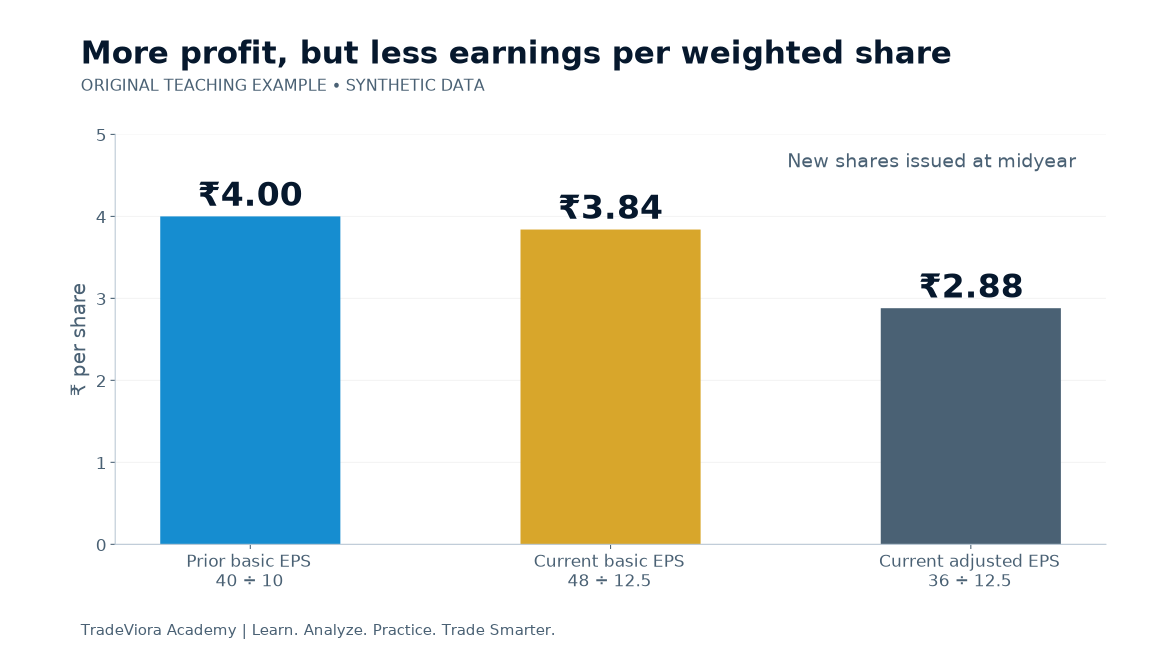
At the exact midpoint of the current year, Company B issues another 5 crore shares. It has 10 crore shares for half the year and 15 crore for the other half. The weighted-average share count is 10 × 0.5 + 15 × 0.5 = 12.5 crore. This example assumes all earnings belong to ordinary shareholders and there are no preference dividends, stock splits or other securities.
Make the denominator match the period
Current basic EPS is ₹48 crore ÷ 12.5 crore shares = ₹3.84. Despite higher total profit, EPS falls 4% from ₹4. Dividing by the year-end 15 crore shares would give ₹3.20, which is not the weighted-average basic EPS for this year.
Issued-share dilution and accounting diluted EPS are related but different ideas. Diluted EPS can also include the effect of qualifying options or convertible securities under applicable accounting rules. We have not invented such instruments here, so this exercise calculates basic EPS after a share issue, not a separate diluted-EPS figure.
| Metric | Prior year | Current year |
|---|---|---|
| Reported profit, ₹ crore | 40 | 48 |
| Weighted shares, crore | 10 | 12.5 |
| Basic EPS, ₹ | 4 | 3.84 |
| Adjusted profit, ₹ crore | Not calculated | 36 |
| Adjusted EPS, ₹ | Not calculated | 2.88 |
Inspect the numerator too
Suppose reported current profit includes a separately disclosed ₹12 crore after-tax gain from selling a warehouse. Removing that gain produces a teaching estimate of recurring profit of ₹36 crore and adjusted EPS of ₹2.88. This adjustment is transparent, but it is an analyst calculation, not a replacement for reported accounting earnings.
At a hypothetical share price of ₹96, reported trailing P/E is 96 ÷ 3.84 = 25 times. The adjusted P/E is 96 ÷ 2.88 = 33.33 times. Neither result alone tells you whether the shares are good value. You still need to understand future profitability, risk, funding and what the new share capital bought.
Do not punish every capital raise
New shares can fund productive investment. Their immediate effect on EPS may look disappointing even when the funds later help the business. Equally, a profit increase can mask weak returns on fresh capital. Follow the cash raised and compare the resulting operating performance over time.
Keep an audit trail: reported profit, each adjustment with its tax treatment, dates of share-count changes and the calculation of weighted shares. Repeatedly labelling ordinary expenses as one-off can flatter adjusted earnings. The useful skill is explaining the bridge, not selecting the smallest P/E.
Try it yourself
If the same 5 crore new shares had been issued on the first day of the year, what would basic EPS be? Keep reported profit at ₹48 crore.
Show the worked answer
The weighted-average count would be 15 crore for the full year. Basic EPS would be ₹48 ÷ 15 = ₹3.20, a 20% fall from ₹4. The difference from ₹3.84 comes entirely from the share-issuance timing; profit is unchanged.
A profit headline becomes useful only when the earnings basis and share-count timing are clear.
Build on the foundation
Sources and method
Written with AI assistance for TradeViora Academy. The examples, arithmetic and charts are newly constructed. Selected book passages informed the concepts; no book figures, tables or paragraphs are reproduced. This is educational material, not an instrument recommendation.
- Fundamental Analysis For Dummies — Matt Krantz (2010). PDF pp. 5–6, 11–12, 129–130, 133–134, 145–146, 199, 201, 203 (selected passages). Cash-flow adjustments, ratios and DCF concepts. New company numbers and all worked examples.
- Guide to Fundamental & Technical Analysis — Tigrent Brands Inc. (2010). PDF pp. 2, 4, 6–10, 110, 144–145 (selected passages). Curriculum coverage and position-sizing concepts.
- SEC: Beginners’ Guide to Financial Statements. Accessed 27 November 2026. Basic statement relationships and ratio context; original examples supply the arithmetic.
Download this case’s synthetic inputs and calculations (JSON)