
Learning goal: Apply body-engulfing and full-range outside-bar definitions to the same exact OHLC inputs.
State the definition you will use
In this exercise, a bullish body-engulfing pair has a down first body and an up second body. The second open is below the first close and its close is above the first open. These strict inequalities avoid ambiguity about equal boundaries. A common reversal interpretation also requires a preceding decline; the two candles alone do not supply that context.
An outside bar uses the full ranges instead: its high exceeds the previous high and its low is below the previous low. The second candle’s colour does not, by itself, determine whether it is an outside bar. Some platforms use inclusive comparisons, so check the implementation rather than relying on the name.
Calculate the body case
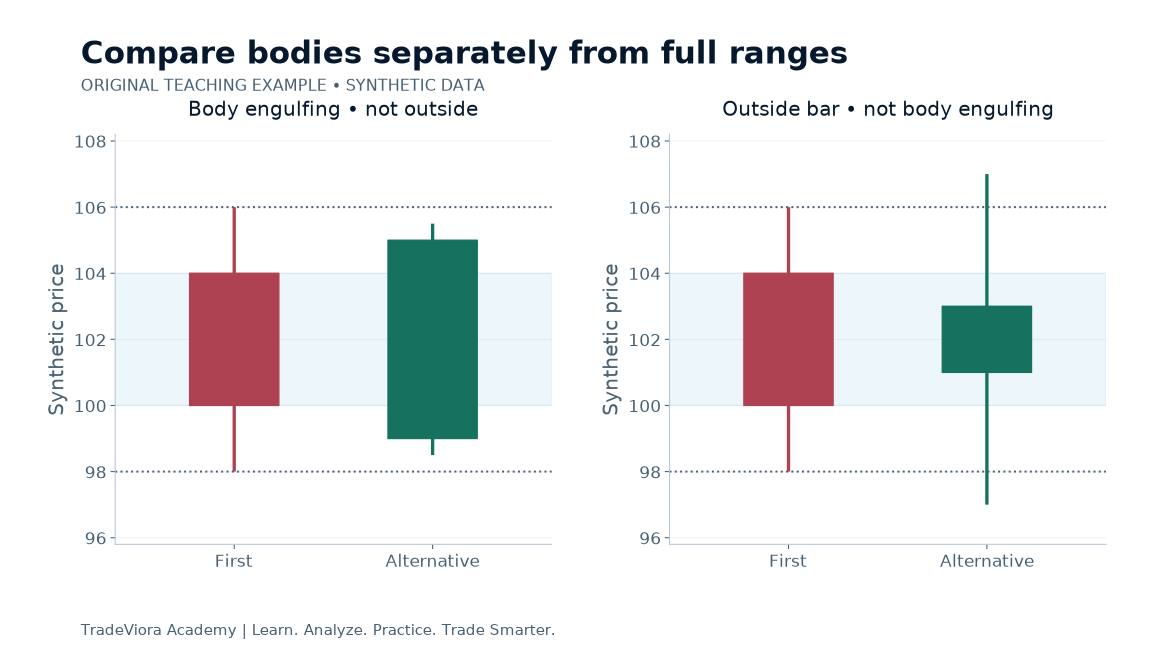
Session 1 opens at 104, trades from 98 to 106 and closes at 100. Its body spans 100–104. Session 2 opens at 99, trades from 98.5 to 105.5 and closes at 105. Its body spans 99–105 and fully contains the first body.
But the second full range, 98.5–105.5, remains inside the first range of 98–106. Therefore the pair meets our body-engulfing definition without being an outside bar. No contradiction is involved: the two tests compare different boundaries.
| Synthetic session | Open | High | Low | Close |
|---|---|---|---|---|
| First | 104 | 106 | 98 | 100 |
| Body engulfing alternative | 99 | 105.5 | 98.5 | 105 |
| Outside-bar alternative | 101 | 107 | 97 | 103 |
Construct the opposite case
Keep Session 1 unchanged. In an alternative Session 2, open at 101, high at 107, low at 97 and close at 103. The high and low exceed the earlier extremes, so it is an outside bar. Its body spans only 101–103, which sits inside the first body. It does not meet our bullish body-engulfing rule.
The chart shows both alternatives beside the same first candle. These are separate synthetic examples, not three consecutive sessions. The alternatives make the distinction clearer than memorizing a picture without the underlying numbers.
Avoid making the pattern definition move
If you change from body boundaries to full-range boundaries after seeing a result, you have changed the research question. Record whether equality counts, how gaps are handled and whether both candles must be complete. A pattern based on the close is only known once that close exists.
The same definition may produce different frequencies in markets with different session gaps. Neither category provides an automatic entry, target or success probability. A useful learning exercise first labels the geometry correctly, then separately evaluates context, execution and outcomes on data that was not used to tune the definition.
Try it yourself
Under the strict body-engulfing rule here, does an alternative second candle opening at 100 and closing at 105 qualify?
Show the worked answer
No. Its open equals, rather than falls below, the previous close of 100. A different rule could allow equality, but it must be specified before testing and labelled consistently. This is a definition choice, not evidence that one rule is profitable.
Write the geometric rule precisely before comparing pattern counts or outcomes.
Build on the foundation
Sources and method
Written with AI assistance for TradeViora Academy. The examples, arithmetic and charts are newly constructed. Selected book passages informed the concepts; no book figures, tables or paragraphs are reproduced. This is educational material, not an instrument recommendation.
- Encyclopedia of Candlestick Charts — Thomas N. Bulkowski (2008). PDF pp. 3, 7–8, 25–26, 28, 30–33, 372–374 (selected passages). Pattern-definition variation and sensitivity of reported results to methods and samples.
- Candlesticks: The Basics — Not established in the supplied PDF excerpt (2000 in filename; imprint not verified). PDF pp. 1–5. Candle geometry and preceding-trend context.
Download this case’s synthetic inputs and calculations (JSON)