
Learning goal: Calculate whole-share quantity with costs and cash constraints, then stress the planned loss with a worse fill.
Build a deliberately simple plan
A fictional learner has ₹2,00,000 available for a cash-share exercise and chooses an illustrative planned loss budget of ₹1,000. This is a teaching input, not a recommended percentage for an account. The hypothetical entry is ₹250 and the planned exit reference is ₹244, leaving ₹6 of price risk per share.
Add an assumed ₹1 per share for round-trip costs and ordinary execution friction. That makes the budgeted loss per share ₹7. The allowance is invented for this exercise; actual brokerage, taxes, spread and slippage depend on the transaction. A cost allowance does not cover every possible gap.
Size with both constraints
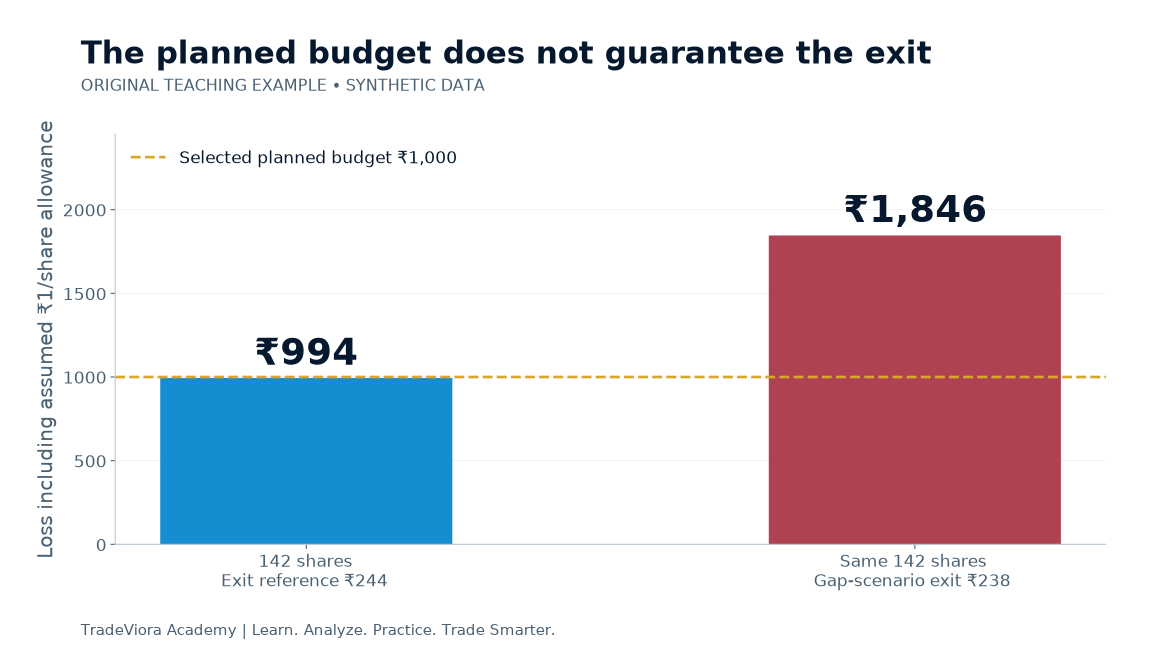
Budget-based quantity is the floor of 1,000 ÷ 7, or 142 whole shares. The price-distance loss is 142 × 6 = ₹852 and the assumed allowance is ₹142, giving ₹994. Buying 143 shares would give ₹1,001, which exceeds the selected budget.
Capital required at entry is 142 × 250 = ₹35,500 before charges, well within ₹2,00,000. Both the loss-budget check and the cash requirement matter. A separate small-cash account could constrain quantity even when the risk calculation allows more. This exercise does not model leveraged derivatives, their contract sizes or margin rules.
| Item | Calculation | Result |
|---|---|---|
| Per-share budget | 250 − 244 + 1 | ₹7 |
| Whole shares | floor(1000 / 7) | 142 |
| Planned loss | 142 × 7 | ₹994 |
| Entry cash | 142 × 250 | ₹35,500 |
| Gap-scenario loss | 142 × (250 − 238 + 1) | ₹1,846 |
Stress the exit
Now suppose the market gaps and the actual exit occurs at ₹238 rather than ₹244. The price loss is 142 × 12 = ₹1,704. Retaining the same simplified ₹142 allowance gives a total loss of ₹1,846. The position sizing arithmetic was correct, yet the realized loss exceeded the planned budget.
A stop-market order becomes a market order when triggered and can execute away from the stop price. A stop-limit order adds a price limit but may not execute. These are general order concepts; availability, triggering and session behaviour must be checked with the relevant broker and exchange.
Use the budget as a planning tool
The gap scenario does not make sizing pointless. It shows why the budget should be described as planned, and why concentrated exposure, event timing and liquidity still matter. Several positions can also move against the account together; separate per-position budgets do not automatically control combined risk.
For a repeatable worksheet, record account cash, selected budget, entry, exit reference, cost assumption, rounded quantity and at least one adverse-fill scenario. Recalculate when any input changes. Do not move the invalidation closer solely to justify a larger size without checking whether the original reasoning still holds.
Try it yourself
If the per-share cost allowance rises to ₹2, what quantity fits the same ₹1,000 planned budget? What if only ₹20,000 cash is available?
Show the worked answer
With a ₹2 allowance, budgeted risk is ₹8 per share, so quantity is 125. With only ₹20,000 cash, no more than 80 shares can be bought at ₹250 before charges; a cash reserve for charges may reduce it further. Use the tighter constraint, and do not label either calculation a guaranteed maximum loss.
Correct sizing controls planned exposure; execution uncertainty can still change the realized loss.
Build on the foundation
Sources and method
Written with AI assistance for TradeViora Academy. The examples, arithmetic and charts are newly constructed. Selected book passages informed the concepts; no book figures, tables or paragraphs are reproduced. This is educational material, not an instrument recommendation.
- Guide to Fundamental & Technical Analysis — Tigrent Brands Inc. (2010). PDF pp. 2, 4, 6–10, 110, 144–145 (selected passages). Curriculum coverage and position-sizing concepts.
- Technical Analysis Plain and Simple, Third Edition — Michael N. Kahn, CMT (2010). PDF pp. 2–3, 6–10, 77–78, 80–81, 112–113, 214–215 (selected passages). Context, support/resistance, pattern failure and entry-price effects.
- SEC Investor.gov: Stop, Stop-Limit, and Trailing Stop Orders. Accessed 27 November 2026. General execution distinction only. Check local broker/exchange availability separately.
Download this case’s synthetic inputs and calculations (JSON)