
FREE FINANCIAL EDUCATION
Long iron condor for two-sided movement
Reverse a short iron condor to obtain a bounded movement payoff.
What you will learn
Prerequisites: Iron-condor legs and reversing position signs.
- Reverse a short iron condor to obtain a bounded movement payoff.
- Compute the central loss region and outer profit caps.
- Distinguish a long iron condor from a long naked strangle.
Mechanism and decision rules
A long iron condor reverses the standard short-credit condor: sell the lowest put, buy the higher put, buy the lower call and sell the highest call, with ordered strikes K 1<K2<K3<K4. It generally pays a net debit D. BetweenK 2 and K 3, all options have zero intrinsic value and loss is D. Beyond either outer wing, the relevant debit spread reaches its width.
For equal widths W, maximum expiry profit is W−D and maximum loss D. Breakevens are K 2−D and K 3+D. The bought inner put and call seek movement, while the sold outer wings reduce cost and cap the benefit of extreme moves. This differs from a long strangle whose upside payoff is not capped by a short call wing.
Worked example · synthetic data
A synthetic position sells 90 put, buys 95 put, buys 105 call and sells 110 call for debit ₹2. Width is ₹5. At expiry S=₹100, loss is ₹2. At ₹92, put-spread value is ₹3 and profit ₹1. At ₹120, call-spread value is ₹5 and profit ₹3.
Breakevens are ₹93 and ₹107. A move beyond ₹110 does not add more expiry profit because the long 105 call and short 110 call gain intrinsic value at the same rate. The package limits both premium risk and extreme-move reward.
Failure modes and limits
Terminology varies, so always list leg signs rather than relying only on the strategy name. Unequal widths produce different side profits. Multi-leg spreads, assignment and delivery affect execution. Before expiry, volatility and time influence value, so the final payoff is not a live pricing model.
Practice case
Equal-width 10 long iron condor costs ₹4, with inner strikes 200 and 220. Find maximum profit, maximum loss and breakevens. What is expiry profit well beyond either outer strike?
Reveal the worked answer
Maximum profit is ₹6 and maximum loss ₹4. Breakevens are 196 and 224. Well beyond either outer strike, the active spread is worth 10 and the other expires without value, so profit is 10−4=₹6 before costs.
Check your understanding
Sources and next steps
The lesson, calculations and synthetic cases are original educational material. References explain underlying contract or chart conventions; none validates the profitability of a trading rule. Actual contract specifications, settlement obligations and charges must be checked before trading.
Explore OHLCV data in the chart lab · Explore volume-at-price and TPO data · Practice library
Related quantitative practice
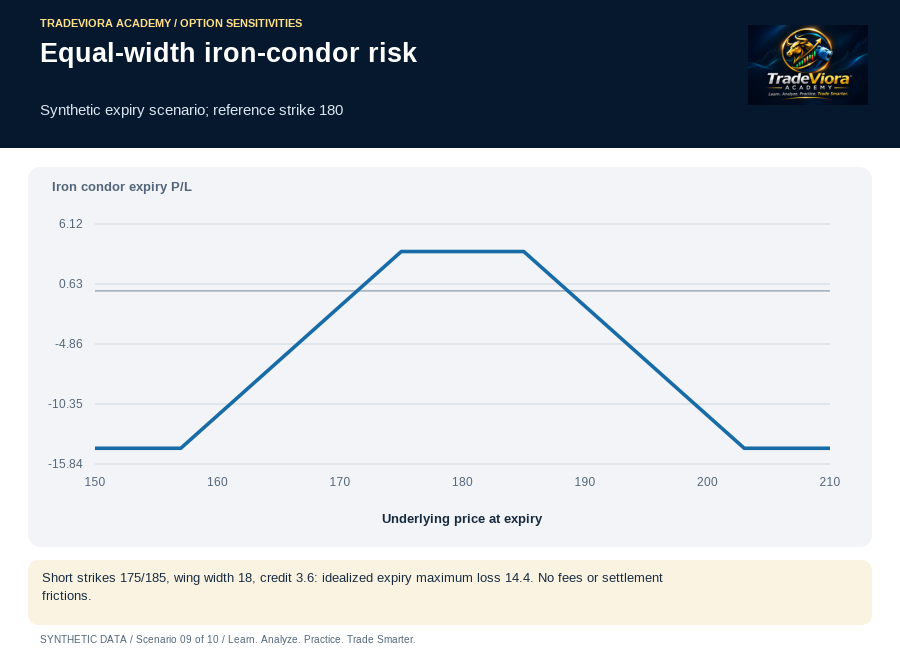
This separate synthetic case illustrates the arithmetic behind the topic. Its invented inputs are independent of the worked example above.
Download this concept’s cheat sheet · Run the related Python example · Explore scenario illustrations