
FREE FINANCIAL EDUCATION
Short strangle and widening tail exposure
Compute the short strangle’s profit interval and breakevens.
What you will learn
Prerequisites: Long-strangle strikes, short calls and short puts.
- Compute the short strangle’s profit interval and breakevens.
- Distinguish wider strike spacing from bounded risk.
- Compare credit size with adverse-tail loss.
Mechanism and decision rules
A short strangle sells a lower-strike putKp and higher-strike callKc at the same expiry and units. Total credit C is maximum expiry profit, earned throughout the interval between strikes. Breakevens areKp−C andKc+C. Outside those points, losses grow; using out-of-the-money strikes creates a wider quiet-price region but does not supply protective wings.
The short call has unbounded upward-price risk in the simplified model, and the short put can loseKp−C as a nonnegative underlying approaches zero. A lower apparent probability of crossing a strike can be offset by a larger loss when it happens. Position size must reflect tail and funding scenarios, not only the attractive distance to the short strikes.
Worked example · synthetic data
A synthetic 90 put and 110 call are sold for total credit ₹6. At expiry S=₹100, profit is ₹6. At ₹85, put intrinsic is ₹5 and profit ₹1. At ₹120, call intrinsic is ₹10 and profit −₹4. Breakevens are ₹84 and ₹116.
At ₹150, loss becomes ₹34 per unit, more than five times the initial credit. The wider 90–110 strike interval did not cap the call liability. Adding bought wings would create a different defined-payoff structure whose cost and width must be calculated separately.
Failure modes and limits
Margin offsets and requirements are not payoff guarantees. A gap can bypass a planned adjustment, and rolling may add new exposure rather than repair the original loss. Multiple short positions can suffer together during volatility shocks. Use actual executable quotes and current settlement rules for any live analysis.
Practice case
Sell a 180 put and 220 call for total credit ₹10. Find breakevens and expiry P&L at 165 and 240. Is maximum loss equal to the credit?
Reveal the worked answer
Breakevens are 170 and 230. At 165, put liability 15 leaves −₹5. At 240, call liability 20 leaves −₹10. Maximum loss is not the credit; upside-price loss is unbounded and downside loss can be large under the stated naked structure.
Check your understanding
Sources and next steps
The lesson, calculations and synthetic cases are original educational material. References explain underlying contract or chart conventions; none validates the profitability of a trading rule. Actual contract specifications, settlement obligations and charges must be checked before trading.
Explore OHLCV data in the chart lab · Explore volume-at-price and TPO data · Practice library
Related quantitative practice
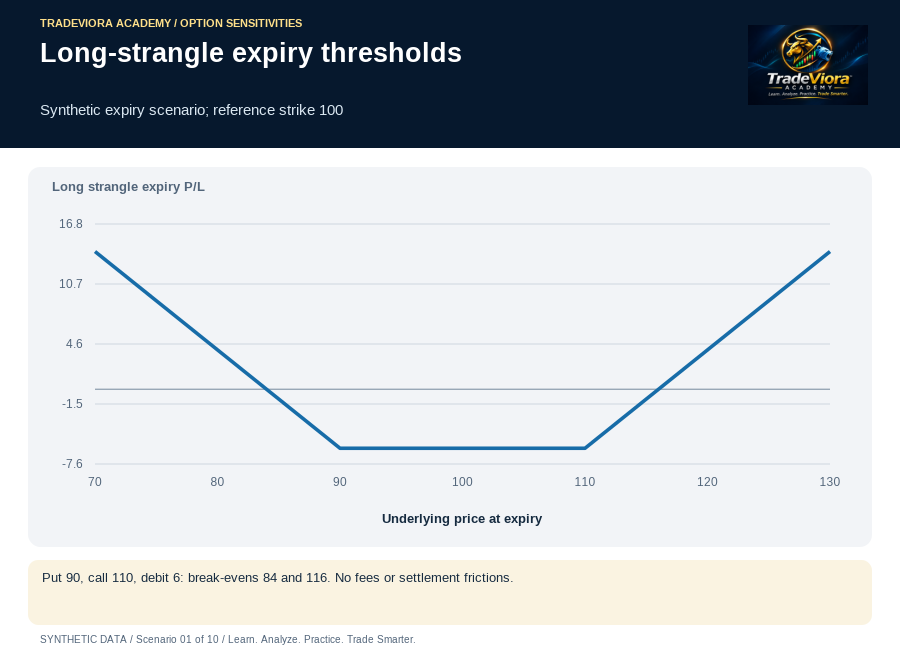
This separate synthetic case illustrates the arithmetic behind the topic. Its invented inputs are independent of the worked example above.
Download this concept’s cheat sheet · Explore scenario illustrations