
FREE FINANCIAL EDUCATION
Bid–ask spread filters
Express spread in price, ticks and as a share of planned reward.
What you will learn
Prerequisites: Bid, ask, midpoint and target-distance arithmetic.
- Express spread in price, ticks and as a share of planned reward.
- Apply a spread eligibility rule using a contemporaneous quote.
- Avoid treating a narrow spread as sufficient evidence of low total execution cost.
Mechanism and decision rules
The quoted spread is ask minus bid at a timestamp and displayed size. For a short-horizon trade, compare it with tick size and the expected price opportunity. A ₹0.20 spread can be negligible for a ₹20 target and dominant for a ₹0.30 target. A filter should state its maximum width, minimum displayed size, quote freshness and whether it uses absolute or relative units.
Spread is only one component of execution cost. Market impact, latency, fees and adverse selection remain. The best bid and ask can move before an order arrives. A narrow quote with tiny size may not support the planned quantity. Recheck critical conditions at order submission rather than relying on a screenshot from the signal’s earlier timestamp.
Worked example · synthetic data
A synthetic quote is bid ₹100.00 and ask ₹100.20 with tick ₹0.05. Spread is ₹0.20 or four ticks. A planned ₹1.00 gross target means the full spread equals 20% of that target. If the rule permits at most three ticks or 15% of target, the candidate fails both tests.
A later quote at 100.10/100.20 narrows spread to two ticks, but eligibility still depends on freshness, size and the remaining entry-to-target distance. The improved spread does not automatically restore the original trade economics if price has already moved.
Failure modes and limits
Quoted spread can understate impact for larger orders. Locked or crossed quotes may be stale or reflect feed issues rather than free execution. A relative-to-target filter can be manipulated by choosing an unrealistic distant target. Thresholds need independent validation and current instrument tick specifications.
Practice case
Bid 250.00, ask 250.30 and tick 0.10 accompany a gross target distance ₹1.50. Compute spread ticks and target share. Does a rule requiring no more than two ticks pass?
Reveal the worked answer
Spread is ₹0.30, or three ticks, and 20% of target distance. It fails the two-tick maximum. The percentage calculation is descriptive; passing another percentage threshold would not override a mandatory tick-width rule.
Check your understanding
Sources and next steps
The lesson, calculations and synthetic cases are original educational material. References explain underlying contract or chart conventions; none validates the profitability of a trading rule. Actual contract specifications, settlement obligations and charges must be checked before trading.
Explore OHLCV data in the chart lab · Explore volume-at-price and TPO data · Practice library
Related quantitative practice
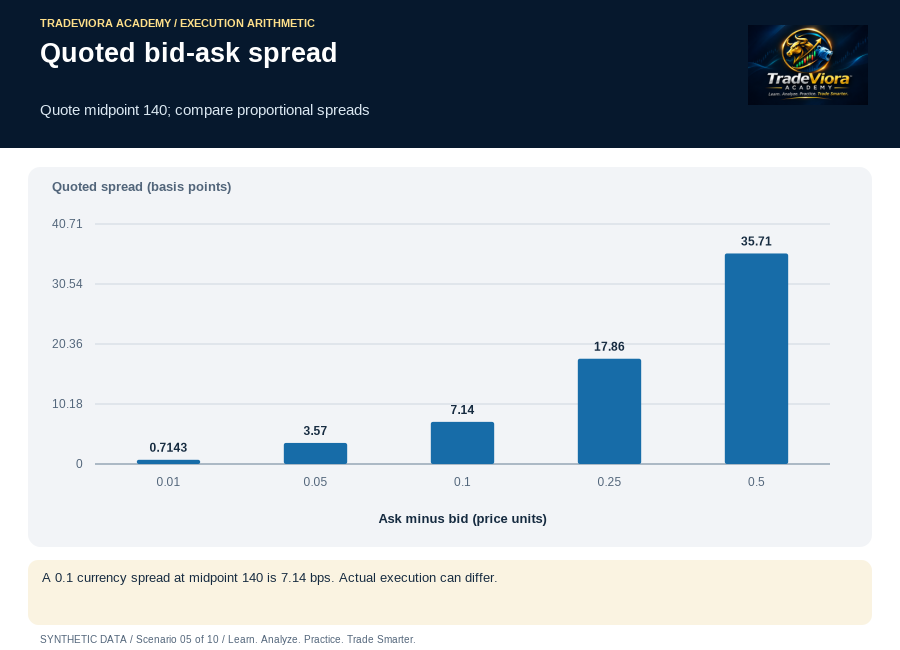
This separate synthetic case illustrates the arithmetic behind the topic. Its invented inputs are independent of the worked example above.
Download this concept’s cheat sheet · Explore scenario illustrations