
FREE FINANCIAL EDUCATION
Relative volume at the same clock time
Compare current cumulative volume with a same-time historical reference.
What you will learn
Prerequisites: Cumulative volume, historical medians and session alignment.
- Compare current cumulative volume with a same-time historical reference.
- Distinguish cumulative relative volume from full-day volume ratios.
- Exclude future session totals from an early-session filter.
Mechanism and decision rules
Intraday volume has a time-of-day pattern, so current cumulative quantity should be compared with a matching clock-time reference. One definition is current cumulative volume through time t divided by the median cumulative volume through t across selected prior comparable sessions. Specify the session start, lookback, exclusions and whether the current incomplete bar is included.
Dividing a morning total by a full-day historical total answers a different question and can make normal activity look unusually low. Using the current day’s eventual total in a morning decision leaks future data. A high same-time ratio describes participation relative to the chosen baseline; it does not prove directional buying or a profitable breakout.
Worked example · synthetic data
At synthetic 10:00, current cumulative volume is 120,000 units. The median through 10:00 over 20 prior comparable sessions is 80,000, giving relative volume 1.5. A median full-day total of 500,000 would produce 0.24, but that is not the same-time ratio.
If the current session later ends at 600,000, that final value was unavailable at 10:00. The strategy’s 10:00 eligibility should remain based on the 120,000 and historical 80,000 known then. Corporate actions and shortened sessions may require separate reference handling.
Failure modes and limits
A small historical sample can be unstable. Event days and holidays can distort the baseline. Reported volume units differ across instruments, and a cash-index proxy must be identified. High relative volume can occur during selling, buying, two-way turnover or auction concentration; it is not signed order flow.
Practice case
At 11:00, cumulative volume is 90,000 and the prior same-time median 60,000. Calculate the ratio. If a half-day session is included in the historical set without adjustment, what comparability issue arises?
Reveal the worked answer
The ratio is 1.5. A shortened session can have a different time-of-day activity pattern and endpoint, so the reference may mix unlike sessions. Use a declared calendar filter or separate baseline rather than silently treating all dates as equivalent.
Check your understanding
Sources and next steps
The lesson, calculations and synthetic cases are original educational material. References explain underlying contract or chart conventions; none validates the profitability of a trading rule. Actual contract specifications, settlement obligations and charges must be checked before trading.
Explore OHLCV data in the chart lab · Explore volume-at-price and TPO data · Practice library
Related quantitative practice
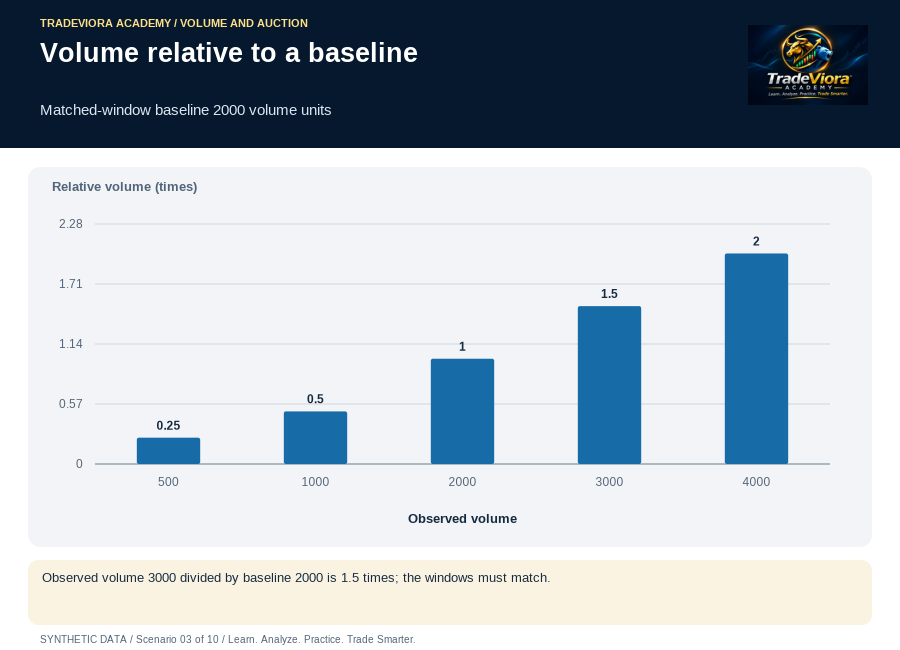
This separate synthetic case illustrates the arithmetic behind the topic. Its invented inputs are independent of the worked example above.
Download this concept’s cheat sheet · Explore scenario illustrations