
FREE FINANCIAL EDUCATION
Normalizing initial-balance size
Scale initial-balance width by a volatility measure available before the session.
What you will learn
Prerequisites: Initial balance, prior-session volatility and scale comparisons.
- Scale initial-balance width by a volatility measure available before the session.
- Distinguish a narrow relative opening from a small nominal price range.
- Avoid denominator leakage from the completed current day.
Mechanism and decision rules
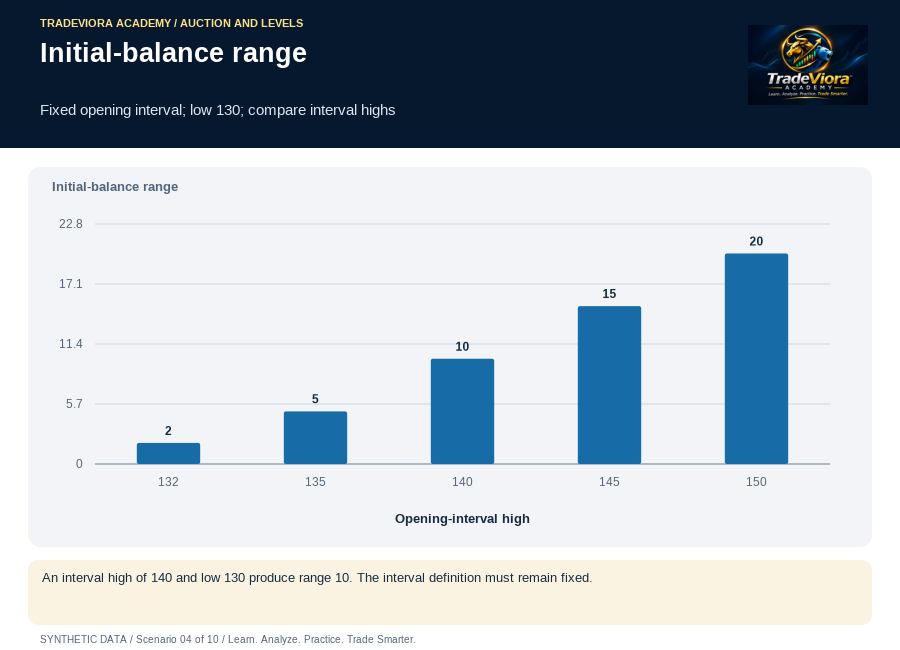
Initial-balance width is the opening interval’s high minus low. Comparing raw widths across instruments or volatility regimes can be misleading. A normalized measure divides it by a predeclared reference, such as the prior finalized average true range or a historical median initial-balance width. The denominator must be available at the decision time and use compatible units.
A low ratio describes a relatively narrow opening interval under that reference. It does not guarantee later expansion or specify direction. A very small denominator can make ratios unstable, and corporate-action or contract adjustments can break comparability. Report the raw width and normalized value together.
Worked example · synthetic data
Synthetic initial balance is 500–506, width 6. The prior finalized ATR is 12, so normalized width is 0.5 ATR. Another instrument has a 20-point balance and prior ATR 80, giving 0.25 ATR. The second range is wider in points but narrower relative to its own volatility scale.
Using today’s eventual full-session range or a volatility estimate that includes later bars would leak future information into an opening filter. A strategy can instead use yesterday’s finalized denominator or a causally updated measure whose availability is explicitly modeled.
Failure modes and limits
ATR and median-range references measure different things and should not be mixed. A narrow opening can precede continued quiet trading. Small samples make historical percentiles unstable. Tick size can impose a lower bound on observable widths, especially in low-priced or illiquid instruments.
Practice case
Initial balance width is 8 and the prior finalized ATR is 20. Compute the ratio. If the current day later ranges 40 points, why should 40 not replace the denominator in the original opening decision?
Reveal the worked answer
The ratio is 8/20=0.4 ATR. The later 40-point range was unavailable when the opening decision was made. Replacing the denominator would retrospectively change the feature and can make the strategy appear to recognize conditions it could not yet know.
Check your understanding
Sources and next steps
The lesson, calculations and synthetic cases are original educational material. References explain underlying contract or chart conventions; none validates the profitability of a trading rule. Actual contract specifications, settlement obligations and charges must be checked before trading.
Explore OHLCV data in the chart lab · Explore volume-at-price and TPO data · Practice library
Related quantitative practice
This separate synthetic case illustrates the arithmetic behind the topic. Its invented inputs are independent of the worked example above.
Download this concept’s cheat sheet · Explore scenario illustrations