
FREE FINANCIAL EDUCATION
Delta versus probability
Distinguish a hedge sensitivity from an expiry exercise probability.
What you will learn
Prerequisites: Delta as a local derivative, normal probabilities and European option pricing assumptions.
- Distinguish a hedge sensitivity from an expiry exercise probability.
- Separate risk-neutral model probabilities from real-world forecasts and probability of profit.
Mechanism and decision rules
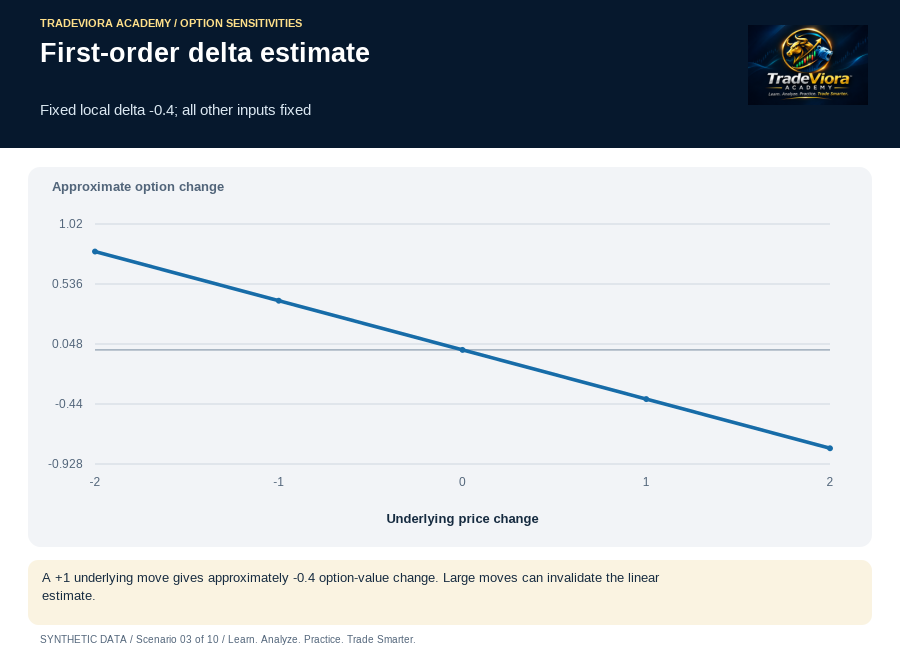
Delta measures a local change in option value for a small change in the underlying price, with the other model inputs held fixed. It is a hedge sensitivity. Traders sometimes use its magnitude as a rough probability shorthand, but the quantities are not generally identical. The distinction matters when a learner interprets a 0.60 delta as an exact sixty-percent probability of making money.
For a non-dividend European call in the Black–Scholes model, delta is N(d1), while the risk-neutral probability of finishing above strike is N(d2). Here N is the standard normal cumulative distribution function and d2 equals d1 minus volatility times the square root of time. With positive volatility and time, those two arguments differ. A continuous dividend yield also introduces a discount factor in the spot delta.
Risk-neutral probabilities support valuation under a model and are not automatically actual-world frequencies. Probability of finishing in the money is also different from probability of profit: an expiry gain must cover the premium and costs. Finally, the probability of touching a level before expiry is a path question, distinct from the probability of ending beyond it. A single delta cannot answer all three questions.
Worked example · synthetic data
Assume spot and strike are both 100, rates and dividends zero, time one year and annual volatility 20%. Then d1 = 0.10 and d2 = −0.10. Call delta is N(0.10) ≈ 0.5398, while the model’s risk-neutral probability of ending above 100 is N(−0.10) ≈ 0.4602. The difference is about 7.97 percentage points. With the corresponding call premium about 7.9656, expiry profit before costs requires a price above roughly 107.9656, not merely above the 100 strike.
Failure modes and limits
These numbers are conditional on a constant-volatility lognormal model. Real returns can jump and exhibit changing volatility. A surface-derived delta can depend on the model and on what is assumed to happen to implied volatility as spot moves. None of these calculations establishes the true likelihood of a specific company’s future price. Keep risk measure, model measure and empirical forecasting evidence labeled separately.
Practice case
Keep spot and strike at 100, rates and dividends zero and time one year, but use annual volatility 40%. Calculate d1 and d2, then use N(0.20) = 0.5792597 and N(−0.20) = 0.4207403 to state delta and risk-neutral exercise probability. Explain why neither number alone is the probability that a purchased call has a positive net expiry profit.
Reveal the worked answer
The arguments are d1 = 0.20 and d2 = −0.20. Delta is about 0.5793 and the model risk-neutral exercise probability about 0.4207, a gap of about 15.85 percentage points. Net profit also depends on the premium and costs, which raise the relevant expiry threshold for a purchased call. A real-world profit probability additionally needs a forecasting distribution rather than simply relabeling a risk-neutral sensitivity.
Check your understanding
Sources and next steps
The lesson, calculations and synthetic cases are original educational material. References explain underlying contract or chart conventions; none validates the profitability of a trading rule. Actual contract specifications, settlement obligations and charges must be checked before trading.
Explore OHLCV data in the chart lab · Explore volume-at-price and TPO data · Practice library
Related quantitative practice
This separate synthetic case illustrates the arithmetic behind the topic. Its invented inputs are independent of the worked example above.
Download this concept’s cheat sheet · Try the related calculator · Explore scenario illustrations