FREE FINANCIAL EDUCATION
Implied-volatility inversion and quote errors
Explain how a numerical solver obtains implied volatility from a premium.
What you will learn
Prerequisites: European pricing inputs, option bounds and the interpretation of vega.
- Explain how a numerical solver obtains implied volatility from a premium.
- Recognize invalid or weakly identified inputs before interpreting the output.
Mechanism and decision rules
An implied-volatility solver searches for the volatility that makes a chosen pricing model match a supplied option premium. Fix spot, strike, time, rates, dividends, exercise style and the premium convention first. In a standard European model with positive time and suitable inputs, option value rises with volatility, allowing a bracketed numerical search. The solver finds a model parameter, not a directly observed future realized volatility.
Check theoretical price bounds before searching. A negative premium, a European call above its appropriate upper bound, or a price below its model’s lower limit cannot be repaired by choosing a more extreme volatility. At expiry, volatility no longer changes the expiry payoff, so an IV is not meaningfully identified. An upper numerical cap should be reported as a search limit rather than a false exact solution.
Vega explains conditioning. A small quote change divided by local vega estimates the change in implied-volatility points when vega is quoted per percentage point. When vega is tiny, even a rounding error or spread can produce a very large IV difference. Displaying many decimals does not make that inferred parameter reliable. Bid, midpoint and ask can legitimately imply different values within the same quoted market.
Worked example · synthetic data
For a synthetic non-dividend European call with spot 100, strike 100, one year remaining and zero interest, the Black–Scholes premium at 20% annual volatility is approximately 7.965567. Feeding that premium back into the same model recovers 20%, subject to numerical precision. A quote of 101 violates the call’s 100 upper bound and must be rejected. In a separate zero-rate case with spot 120 and strike 100, a premium of 19 is below the 20 lower bound, so a negative or imaginary IV would not be a valid repair.
Failure modes and limits
A last trade can be stale while the underlying price is current. Incorrect multipliers, currency units, dividends or expiry timestamps can create impossible inputs. American exercise requires an appropriate model. Deep in-the-money prices may have little separately observable time value after rounding. Record the quote source and solver status alongside IV rather than silently replacing errors with zero or the maximum allowed value.
Practice case
Use a non-dividend European call with spot 50, strike 50, one year remaining and zero rate. Its supplied theoretical premium is 7.92597094. Verify that 40% annual volatility reproduces it. The supplied local vega is 0.19552135 per volatility percentage point. Estimate the IV-point effect of a 0.05 premium perturbation. Compare it with an unrelated option whose vega is only 0.01 in the same units.
Reveal the worked answer
The stated inputs and 40% volatility give approximately 7.92597094, so the inversion recovers 40% within rounding tolerance. The local IV change is 0.05/0.19552135 ≈ 0.2557 percentage points. At vega 0.01, the same premium perturbation corresponds locally to five IV points. That contrast shows why quote precision and a displayed decimal count cannot substitute for adequate sensitivity and accurate contract inputs.
Check your understanding
Sources and next steps
The lesson, calculations and synthetic cases are original educational material. References explain underlying contract or chart conventions; none validates the profitability of a trading rule. Actual contract specifications, settlement obligations and charges must be checked before trading.
- www.ma.imperial.ac.uk: reference documentation
- www.ocw.mit.edu: reference documentation
- www.optionseducation.org: reference documentation
Explore OHLCV data in the chart lab · Explore volume-at-price and TPO data · Practice library
Related quantitative practice
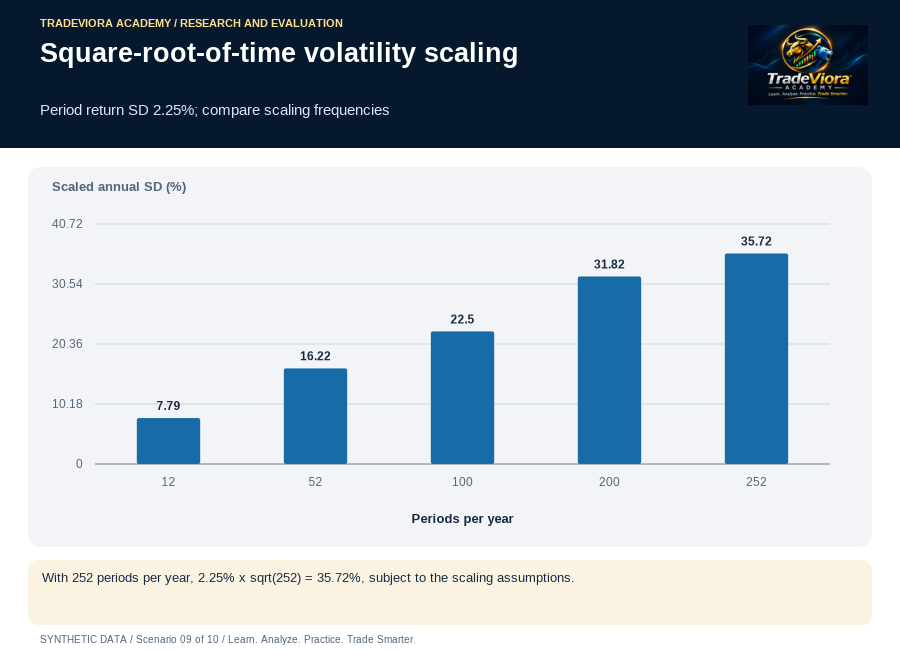
This separate synthetic case illustrates the arithmetic behind the topic. Its invented inputs are independent of the worked example above.
Download this concept’s cheat sheet · Run the related Python example · Explore scenario illustrations
Apply the measurement to genuine historical data
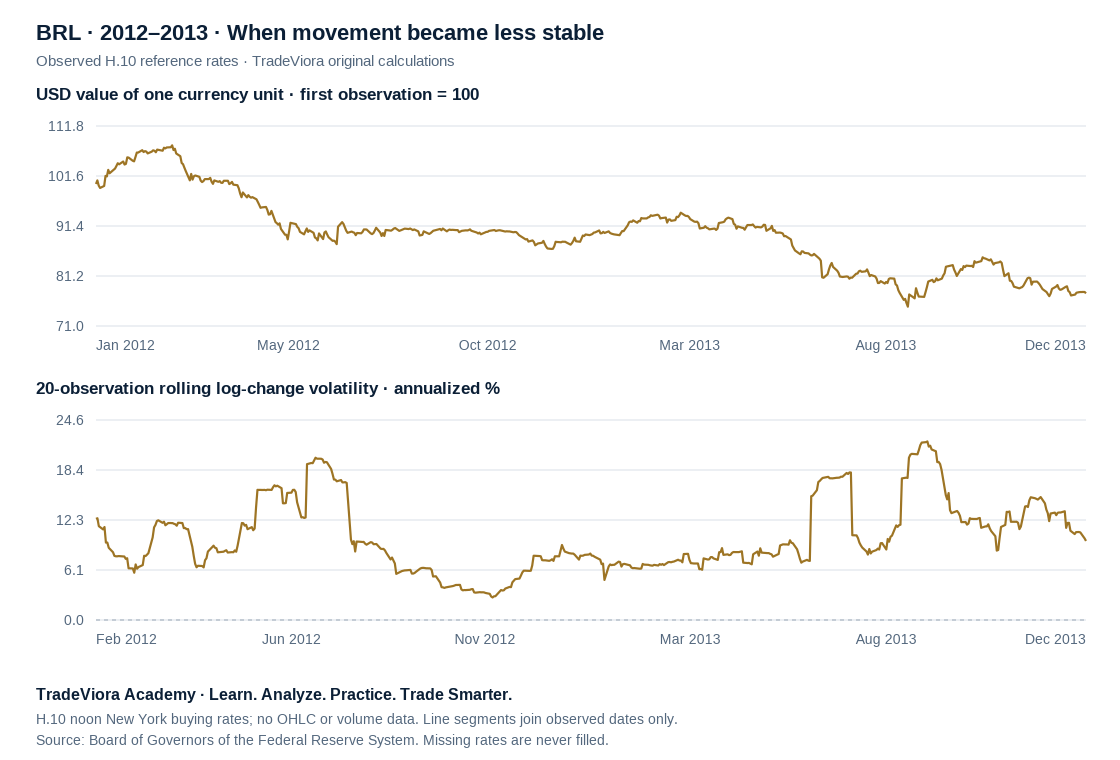
Brazilian real, 2012–2013: when movement became less stable uses Federal Reserve H.10 reference-rate observations. It is an FX measurement exercise, not a test of a trading strategy or an OHLC candlestick record.