
FREE FINANCIAL EDUCATION
ATR stop calibration and gap-aware ranges
Calculate true range and a specified ATR smoothing update.
What you will learn
Prerequisites: OHLC prices, prior closes, arithmetic averages and planned stop risk.
- Calculate true range and a specified ATR smoothing update.
- Translate an ATR multiple into price distance while preserving the limitation of stop execution.
Mechanism and decision rules
True range includes the distance from the prior close as well as the current high-low span. It is the maximum of high minus low, absolute high minus previous close, and absolute low minus previous close. This makes a gap visible even when the current session’s intraday range is narrow. True range is nonnegative and describes magnitude rather than direction.
Average true range then smooths a sequence of true ranges. A simple average and Wilder-style recursive smoothing are different conventions. The latter update, after a declared seed, is previous ATR times n minus one, plus new true range, all divided by n. State the period, seed and smoothing method so another reader can reproduce the value rather than merely matching an indicator label.
An ATR stop proposal converts this historical scale into a price distance, such as entry minus a chosen multiple of ATR for a long. The multiplier is a strategy assumption to test. ATR is not a maximum adverse move and does not make the stop a guaranteed fill. It also does not ensure that the stop corresponds to the economic invalidation of the particular trade thesis.
Worked example · synthetic data
Three hypothetical sessions produce true ranges as follows. With previous close 100, high 104 and low 102, true range is max(2, 4, 2) = 4. With previous close 103, high 106 and low 101, it is 5. With previous close 102, high 103 and low 99, it is 4. Their simple average is 13/3, about 4.33. Separately, a three-period Wilder update from previous ATR 4 and new true range 7 gives (2 × 4 + 7)/3 = 5. A long entry 110 with a two-ATR stop using that updated value proposes stop 100.
Failure modes and limits
Do not combine a simple-average seed with a different platform’s unrecorded smoothing history and expect identical values. Corporate actions, missing sessions and inconsistent previous closes can distort ranges. A large recent gap can widen ATR after the event, but using that revised value for a decision before the gap introduces hindsight. Test calibration on data available at the actual entry time.
Practice case
Previous five-period Wilder ATR is 6 and the new completed true range 11. Calculate the updated ATR. For a long entry 200, use a 1.5-ATR stop distance and a 1,050 planned price-risk allowance. Calculate stop price and whole-share quantity before costs. Explain why a later gap through the stop can still exceed that allowance.
Reveal the worked answer
Updated ATR is (4 × 6 + 11)/5 = 7. The distance is 1.5 × 7 = 10.5, so proposed stop is 189.5. The allowance permits 1,050/10.5 = 100 shares. A stop triggers an order under the relevant broker rules; if liquidity is only available below 189.5, the realized loss can be larger. Historical ATR and a planned distance do not bound every future price change.
Check your understanding
Sources and next steps
The lesson, calculations and synthetic cases are original educational material. References explain underlying contract or chart conventions; none validates the profitability of a trading rule. Actual contract specifications, settlement obligations and charges must be checked before trading.
Explore OHLCV data in the chart lab · Explore volume-at-price and TPO data · Practice library
Related quantitative practice
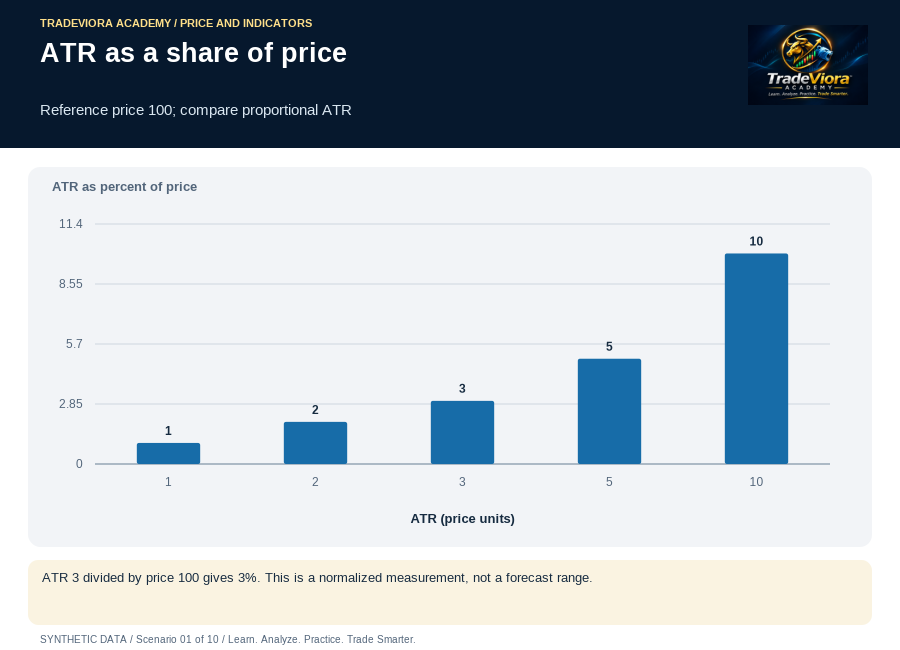
This separate synthetic case illustrates the arithmetic behind the topic. Its invented inputs are independent of the worked example above.
Download this concept’s cheat sheet · Run the related Python example · Explore scenario illustrations