
1. What is the main weighted average fill?
- $50.30
- $50.25
- $50.20
Reveal answer and explanation
A. The 200-share fill has twice the weight of the 100-share fill.
FREE FINANCIAL EDUCATION
Study vwap benchmark shortfall: direction, costs and comparison windows through mechanisms, a synthetic worked case, practice, and explained assessment.
Volume and Volume Spread Analysis
APPLIED STUDY · ORIGINAL LESSON
Before you begin: Complete VWAP, weighted-average fill price and basis points, where one basis point equals 0.01%.
An execution benchmark compares realized fills with a specified reference price. Against VWAP, a buyer pays an adverse price difference when its weighted fill exceeds the benchmark; a seller receives an adverse difference when its fill is below the benchmark. This lesson reports positive numbers as costs and negative numbers as improvements. With side s equal to +1 for a buy and -1 for a sell, gross benchmark cost is s times (average fill minus benchmark) times quantity. Add separately recorded fees to obtain all-in cost under the declared scope.
Basis-point cost divides monetary cost by benchmark price times executed quantity, then multiplies by 10,000. The benchmark must match the intended instrument, venue coverage and evaluation interval. A whole-session VWAP is a later evaluation statistic until the session is complete, so it cannot be inserted into an earlier causal signal. Whether the trader's own executions are included in the market benchmark is another convention that should be recorded, especially when the trader represents a substantial share of volume.
A synthetic buy fills 100 shares at $50.10 and 200 at $50.40. Total paid is $15,090 and weighted average fill is $50.30. Matching-window VWAP is $50.20. Gross benchmark cost is $0.10 times 300 = $30, approximately 19.92 basis points of the $15,060 benchmark notional. Fees of $0.02 per share add $6, giving $36 all-in cost, approximately 23.90 basis points.
Suppose the order's arrival reference was instead $49.80. For this fully executed toy order, arrival-price cost including the same fees is ($50.30-$49.80) times 300 plus $6 = $156. This is a different benchmark comparison, not a contradiction. A complete implementation-shortfall analysis for a partially filled order can additionally require an explicit treatment of unexecuted quantity and opportunity cost, which the fully filled example does not contain.
Beating session VWAP does not establish that an investment decision was profitable, because the asset can move unfavorably before or after the evaluation window. Changing the benchmark window after seeing fills can also flatter an execution result. Keep signed gross price cost, explicit fees and total cost in separate fields. Rebates, taxes, financing and currency conversion require their own declared treatment rather than being silently assumed to be zero or included twice.
A synthetic sell executes 400 shares at weighted price $80.10 against matching-window VWAP $80.00. Fees are $0.025 per share. Use positive values for adverse cost. Calculate gross benchmark cost, fees, all-in cost and all-in basis points. Explain why the gross sign differs from a buy at the same two prices.
A seller benefits from receiving above the reference, so gross cost is ($80.00-$80.10) times 400 = -$40. Fees are $10, leaving all-in cost -$30, an improvement of $30 under this convention. Divide by benchmark notional $32,000 and multiply by 10,000 to get -9.375 basis points. A buyer paying $80.10 against $80.00 instead incurs a positive price cost because paying more is adverse for that side.
Choose an answer before opening each explanation. These questions test the specific mechanism in this lesson.
A. The 200-share fill has twice the weight of the 100-share fill.
B. The sign compares execution with a reference; it does not describe every later economic outcome.
C. The selected benchmark determines the comparison being measured.
Original explanation and synthetic calculations. Chart thresholds are explicit research conventions, not exchange rules or proof of predictive ability.
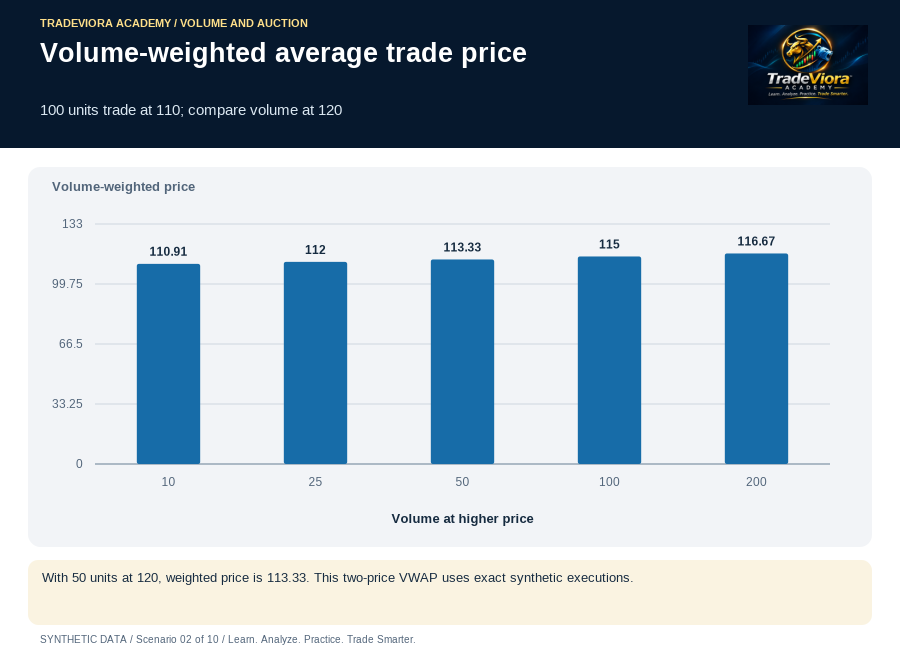
This separate synthetic case illustrates the arithmetic behind the topic. Its invented inputs are independent of the worked example above.
Download this concept’s cheat sheet · Run the related Python example · Explore scenario illustrations