
FREE FINANCIAL EDUCATION
Vega
Apply vega using percentage-point volatility units.
What you will learn
Prerequisites: Implied volatility, option units and local sensitivity approximations.
- Apply vega using percentage-point volatility units.
- Aggregate signed vega for matching underlying and expiry assumptions.
- Explain why a volatility increase need not produce a net option gain.
Mechanism and decision rules
Vega measures option-value sensitivity to implied volatility under a pricing model. Trading displays commonly quote value change for a one-percentage-point change, such as 20% to 21%, but some libraries use a change of 1.0 in decimal volatility, equivalent to 100 percentage points. Unit conversion is essential. A standard long option usually has positive vega; a short position reverses that exposure.
Vega describes one input at a time. The actual premium can fall despite higher IV if adverse underlying movement or time passage dominates. Different strikes and expiries may experience different volatility changes, so adding all vegas and applying one parallel shock is a simplified scenario. Term-structure and skew risk require more detailed shocks.
Worked example · synthetic data
A synthetic long option has vega ₹0.80 per unit per one percentage point. IV rises from 24% to 27%, a three-point increase. The local vega contribution is 0.80 × 3 = ₹2.40 per unit. Across 50 units, that is ₹120.
If a library instead reports vega 80 per unit per 1.0 decimal-volatility change, multiply by 0.03 to obtain the same ₹2.40. Multiplying that 80 by three would exaggerate the effect one hundredfold. The calculation assumes other pricing inputs remain fixed.
Failure modes and limits
Vega changes with spot, time and IV, and large shocks require full repricing. Bid and ask IVs can differ substantially. A portfolio with zero summed vega can remain exposed to nonparallel changes across strikes and maturities. Event-related IV changes can occur simultaneously with large underlying jumps.
Practice case
You are short 100 units with long-option vega ₹0.50 per percentage point. IV falls from 30% to 26%. Calculate the approximate vega contribution to the short position’s P&L.
Reveal the worked answer
The long option’s contribution is 0.50 × (−4) = −₹2 per unit. The short gains the opposite, +₹2 per unit or +₹200 for 100 units. This is one component of P&L; movement, time and execution effects remain.
Check your understanding
Sources and next steps
The lesson, calculations and synthetic cases are original educational material. References explain underlying contract or chart conventions; none validates the profitability of a trading rule. Actual contract specifications, settlement obligations and charges must be checked before trading.
Explore OHLCV data in the chart lab · Explore volume-at-price and TPO data · Practice library
Related quantitative practice
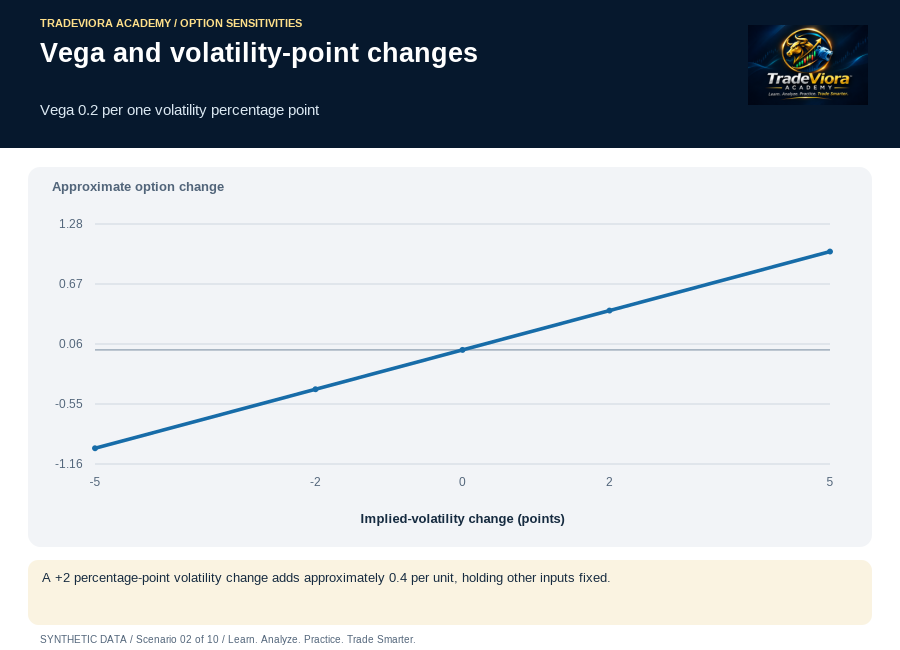
This separate synthetic case illustrates the arithmetic behind the topic. Its invented inputs are independent of the worked example above.
Download this concept’s cheat sheet · Explore scenario illustrations