
FREE FINANCIAL EDUCATION
Broken-wing call butterfly
Calculate an asymmetric 1:−2:1 call payoff across unequal wings.
What you will learn
Prerequisites: Symmetric butterflies and unequal strike spacing.
- Calculate an asymmetric 1:−2:1 call payoff across unequal wings.
- Identify which tail carries residual risk.
- Avoid applying symmetric-butterfly formulas to unequal widths.
Mechanism and decision rules
A broken-wing call butterfly retains the 1 long lower,2 short middle,1 long upper ratio but uses unequal strike spacing. Let lower width W 1=K2−K1 and upper width W 2=K3−K2. AboveK 3, net intrinsic payoff is W 1−W2, rather than automatically zero. The initial debit or credit must then be included to determine tail profit or loss.
Unequal wings can shift cost and risk to one side. A credit entry does not imply no loss, and a wider upper wing can leave a negative high-price plateau. Derive the piecewise payoff directly from the actual strikes. The label butterfly is insufficient to establish the symmetric risk bounds.
Worked example · synthetic data
A synthetic call structure buys 90, sells two 100 and buys 120 calls for net credit ₹1. Lower width is 10 and upper width 20. Below 90, intrinsic payoff is zero and profit ₹1. At 100, intrinsic is 10, giving ₹11 profit. Above 120, intrinsic is 10−20=−10, so profit is −₹9.
At 110, intrinsic is 20−2×10=0, leaving ₹1. Upper breakeven occurs at 111 because profit in the 100–120 region is 111−S. The structure receives a credit yet has a ₹9 maximum static upper-tail loss per unit.
Failure modes and limits
A different ratio or wing orientation changes the result. Credit quotes at midpoint may be unattainable. Assignment, delivery and separate leg execution can create obligations not shown by the final plateau. Do not describe a broken-wing structure as riskless merely because one tail has no loss.
Practice case
Buy 100 call, sell two 110 calls and buy 130 call for a ₹2 credit. Compute profit below 100, at 110 and above 130. Find the upper breakeven.
Reveal the worked answer
Below 100 profit is ₹2. At 110 intrinsic is 10, so profit ₹12. Above 130 net intrinsic is 10−20=−10, so profit −₹8. Between 110 and 130, profit is 122−S, giving upper breakeven 122.
Check your understanding
Sources and next steps
The lesson, calculations and synthetic cases are original educational material. References explain underlying contract or chart conventions; none validates the profitability of a trading rule. Actual contract specifications, settlement obligations and charges must be checked before trading.
Explore OHLCV data in the chart lab · Explore volume-at-price and TPO data · Practice library
Related quantitative practice
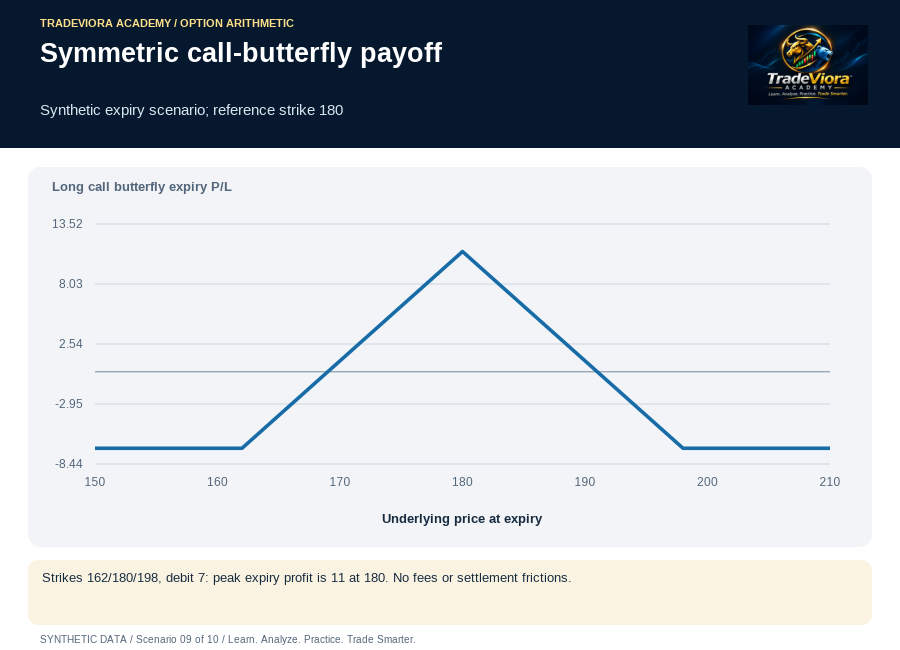
This separate synthetic case illustrates the arithmetic behind the topic. Its invented inputs are independent of the worked example above.
Download this concept’s cheat sheet · Run the related Python example · Explore scenario illustrations