
FREE FINANCIAL EDUCATION
Long strangle
Construct a long put below and long call above the starting reference.
What you will learn
Prerequisites: Straddle mechanics and out-of-the-money option payoffs.
- Construct a long put below and long call above the starting reference.
- Calculate the two expiry breakevens from separate strikes.
- Compare the zero-payoff interval with a same-strike straddle.
Mechanism and decision rules
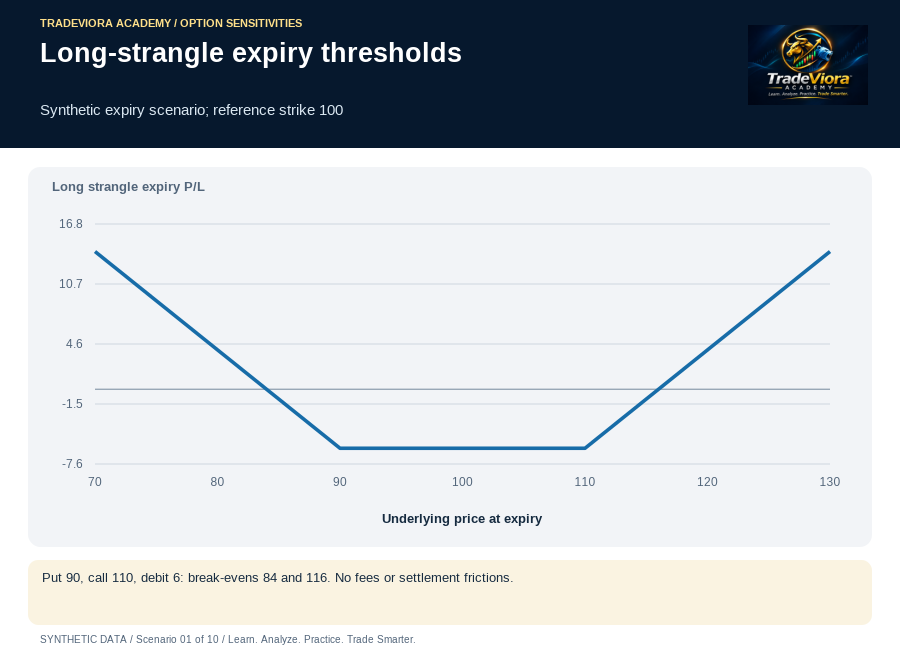
A long strangle buys a lower-strike put Kp and higher-strike call Kc with the same expiry and matching units. Total debit D is the sum of premiums. Between Kp and Kc at expiry, both options have zero intrinsic payoff, so the full debit is lost throughout that interval. Below Kp, the put creates payoff; above Kc, the call does.
Breakevens are Kp − D and Kc + D. Selecting farther out-of-the-money strikes can reduce premium relative to a nearby straddle, but it also increases the movement needed to reach profitable expiry regions. A lower rupee cost is not automatically better value. Compare distributions, event timing, liquidity and pre-expiry exit plans rather than choosing solely by cheapness.
Worked example · synthetic data
Buy a synthetic strike-90 put for ₹3 and strike-110 call for ₹4. Debit is ₹7. At expiry S = ₹100, both expire without intrinsic value and profit is −₹7. At ₹80, put payoff is ₹10 and profit ₹3. At ₹120, call payoff is ₹10 and profit ₹3.
Breakevens are ₹83 and ₹117. Any settlement from ₹90 through ₹110 produces the same full premium loss before fees. The interval of maximum loss is therefore wider than the single-point maximum-loss location of an ideal same-strike straddle.
Failure modes and limits
Farther strikes may have wider relative spreads and less reliable IV estimates. Two-legged execution can leave temporary directional exposure. A volatility increase may lift the package before expiry, but a favorable IV change is not guaranteed. Contract settlement and unit matching remain essential.
Practice case
A 200 put costs ₹6 and a 230 call costs ₹5. Find total debit, lower and upper breakevens, and expiry P&L at S = ₹190 and S = ₹225.
Reveal the worked answer
Debit is ₹11. Breakevens are ₹189 and ₹241. At ₹190, put intrinsic is ₹10, so profit is −₹1. At ₹225, both options have zero intrinsic value, so loss is the full ₹11. A move below the put strike can still fail to recover premium.
Check your understanding
Sources and next steps
The lesson, calculations and synthetic cases are original educational material. References explain underlying contract or chart conventions; none validates the profitability of a trading rule. Actual contract specifications, settlement obligations and charges must be checked before trading.
Explore OHLCV data in the chart lab · Explore volume-at-price and TPO data · Practice library
Related quantitative practice
This separate synthetic case illustrates the arithmetic behind the topic. Its invented inputs are independent of the worked example above.
Download this concept’s cheat sheet · Explore scenario illustrations