
FREE FINANCIAL EDUCATION
Iron condor
Combine two nonoverlapping credit spreads into a bounded expiry structure.
What you will learn
Prerequisites: Put and call credit spreads with same-expiry matched units.
- Combine two nonoverlapping credit spreads into a bounded expiry structure.
- Compute maximum loss when wing widths are equal or unequal.
- Explain why two-sided exposure does not mean both maximum wing losses occur simultaneously at expiry.
Mechanism and decision rules
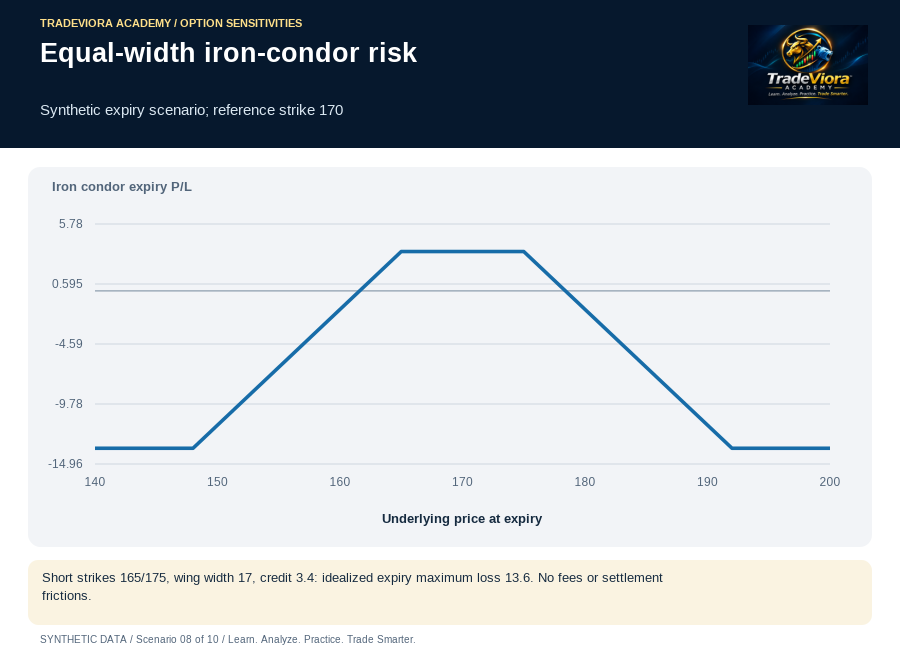
A standard short iron condor buys a lower put, sells a higher put, sells a lower call and buys a higher call, with strikes ordered K1 < K2 < K3 < K4 and matching expiry and units. Net credit C is received. Between the short strikes K2 and K3 at expiry, all intrinsic obligations net to zero and profit is C.
Below K1, the put wing loses its width K2 − K1 before credit; above K4, the call wing loses K4 − K3. For equal widths W, maximum expiry loss is W − C, not twice W − C, because a single settlement cannot be simultaneously below the lower wing and above the upper wing. With unequal widths, use the larger wing width minus total credit.
Worked example · synthetic data
A synthetic condor buys the 90 put, sells the 95 put, sells the 105 call and buys the 110 call for total credit ₹2. Each wing is ₹5 wide. Maximum profit is ₹2 and maximum loss ₹3 per unit. Breakevens are ₹93 and ₹107.
At expiry S = ₹92, the put spread has ₹3 liability and the call spread zero, so profit is 2 − 3 = −₹1. At S = ₹120, the call spread liability is capped at ₹5, leaving −₹3. The lower wing does not add another ₹5 loss in that same final state.
Failure modes and limits
This bounded result assumes matching intact legs through settlement. A position adjusted over time can lose on both sides sequentially even though the static expiry maximum uses one side. Multiple legs increase fees and operational complexity. Assignment, broker liquidation and liquidity can disrupt the theoretical package.
Practice case
A condor has put-wing width ₹10, call-wing width ₹15 and total credit ₹4. Find maximum expiry profit and loss. If the short put strike is 200 and short call strike 230, find breakevens.
Reveal the worked answer
Maximum profit is ₹4. Maximum loss is 15 − 4 = ₹11 on the wider call wing; lower-side maximum loss is ₹6. Breakevens are 200 − 4 = ₹196 and 230 + 4 = ₹234. Width asymmetry creates different tail losses.
Check your understanding
Sources and next steps
The lesson, calculations and synthetic cases are original educational material. References explain underlying contract or chart conventions; none validates the profitability of a trading rule. Actual contract specifications, settlement obligations and charges must be checked before trading.
Explore OHLCV data in the chart lab · Explore volume-at-price and TPO data · Practice library
Related quantitative practice
This separate synthetic case illustrates the arithmetic behind the topic. Its invented inputs are independent of the worked example above.
Download this concept’s cheat sheet · Run the related Python example · Explore scenario illustrations